



The online event will be hosted on 
You can connect with other conference guests and have easy access to other event details.
Please click here to have a tour of the Virtual Event.
Registered participants will have full access to all session contents, interactions and networking. As a registered participant, you will be able to:
No participation fees will be charged.
After your registration is confirmed, you will receive an email with the details to access and follow the virtual event on Brella, which is the official event platform for the European Polar Science Week 2020.
Polar regions are sentinels of climate change and human resilience. They have experienced the most rapid rates of warming in recent years. Its expected impacts will exceed those forecasted for many other regions, resulting in significant consequences affecting natural ecosystems and human activities.
Improving our observation capacity and enhancing the basic understanding of the drivers and processes governing those changes, and translate knowledge into solutions for society, are major challenges for the future.
Earth observation from space and Earth system science will represent an essential element in this process. Addressing the major challenge in Polar research will require a significant collaborative effort and an integrated approach to science where the synergistic use of satellite data, in-situ and citizen observations, advanced modelling capabilities, interdisciplinary research and new technologies will be essential elements.
This is why the European Commission (Directorate General for Research and Innovation) and the European Space Agency are working together to improve cooperation and to identify the grand science challenges in Polar research that may drive joint EC-ESA scientific activities in the coming years.
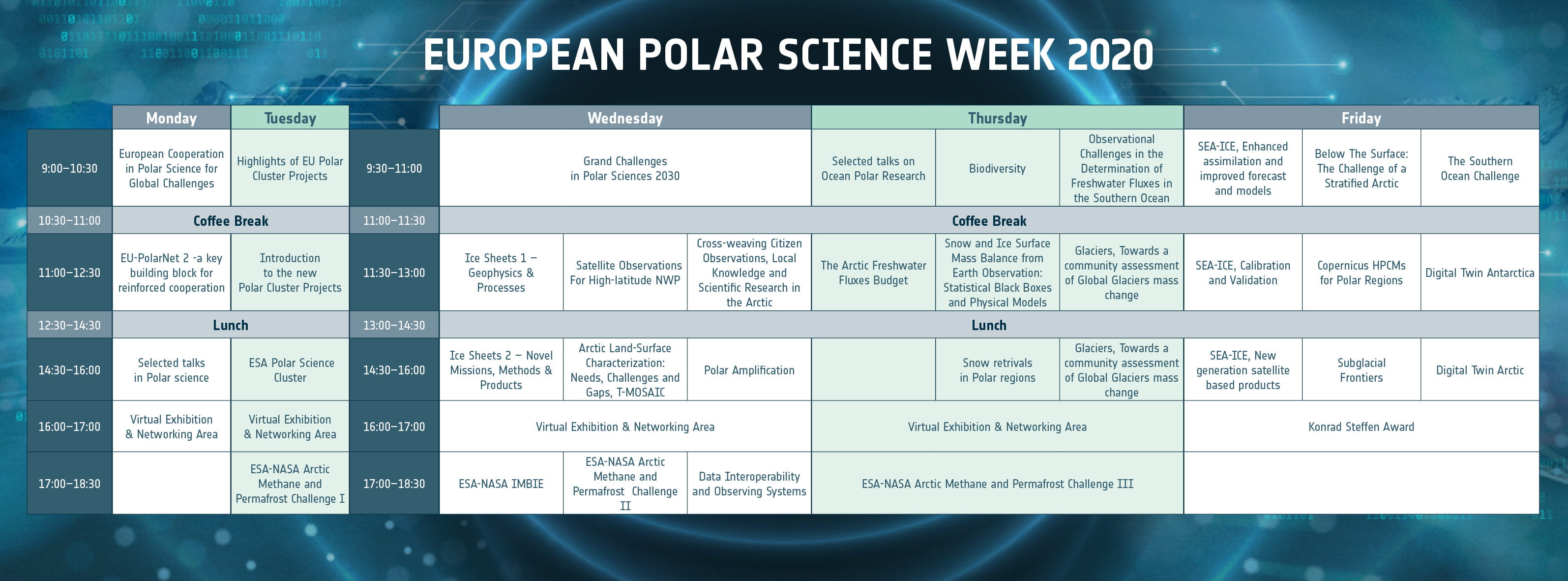
The European Polar Science Week is one of the first results of this increased cooperation between the two organisations. It will take place on-line during October 26-30 2020.
The overall objective of the European Polar Science Week is to bring together the European Polar science community, and reinforce European cooperation for Polar Science.
More specifically, the Polar Science Week will aim to:
During this week, key scientists and stakeholders of Polar Science will have the opportunity discuss the major challenges and opportunities in front of us, promote networking and collaboration across projects and activities and support ESA and the EC to collect recommendations for the future Polar science priorities in Europe.
The European Polar Science Week is organised by the European Space Agency and the European Commission together with EASME (the European Executive Agency for SMEs) and EU PolarNet.
The European Polar Science Week will contribute to the implementation of several major policy initiatives:
The results of this event could feed into the revision of the EU Arctic policy, for which an open public consultation has been launched in July this year. The Public consultation is open until 6 November 2020, don’t hesitate to take part!
The event will take place on-line and will comprise different type of sessions promoting different levels of interaction with the community:
The event is open to Polar researchers and students, modellers, Earth system and climate scientists, industry, policy makers, representatives of local communities and other stakeholders interested in sharing their knowledge and experience and contributing to drive the European polar scientific agenda.
The event will be virtual with all presentations and discussions done remotely.
Additional information on the virtual event will be provided in the coming weeks.
Stay tuned!
The event will be held online on 26-30 October 2020.
Additional information on the virtual event will be provided in the coming weeks.
Stay tuned!
| Abstract submission opening | 17 December 2019 |
| Abstract submission closure | Closed |
| Notification of acceptance | 30 September 2020 |
| Issue of Preliminary Programme | 30 September 2020 |
| Virtual Event | 26-30 October 2020 |
AWI
Nikal Solutions
ESA
ESA
DTU
ESA
EC-EASME
Serco/ESA-ESRIN
EC
Serco/ESA-ESRIN
Nikal Solutions
EC
EC
AWI
EC
EC-EASME
University of Bristol
ESA
INRS-ETE
ESA
GEUS
DMI
UiT & AWI
ESA
University of Waterloo Canada
ESA
British Antarctic Survey
British Antarctic Survey
CSIC
Norwegian Polar Institute
University of Edinburg
University of Leeds
AWI
Niels Bohr Institute
NERSC
ESA
CNR
Norwegian Polar Institute
ASIAQ Greenland
University of Lancaster
Alfred-Wegener-Institut
University of Lapland
DMI
Enveo
DMI
ESA
Finish Meteorological Institute
UC Irvine / NASA JPL
DTU
NERSC
University of Leeds
Norwegian Computing Center
UCL
FMI
Columbia University
DTU
ESA
University of Lisboa